Get Your Free Linchpin Funnel And Join The Free Linchpin Group!

How I Validated A Brand New Feature In One Afternoon
You know the feeling. You describe an idea to an AI builder and it comes back with something that technically works.
And your first reaction is.. that's cool, but that's kind of "not it".
By the time you notice, you've already spent a ton of tokens..
Both on the look and feel, and on everything underneath it, the database, the schema, the routes you didn't even know you'd need yet.
I've been burned by this enough times to now do something different.
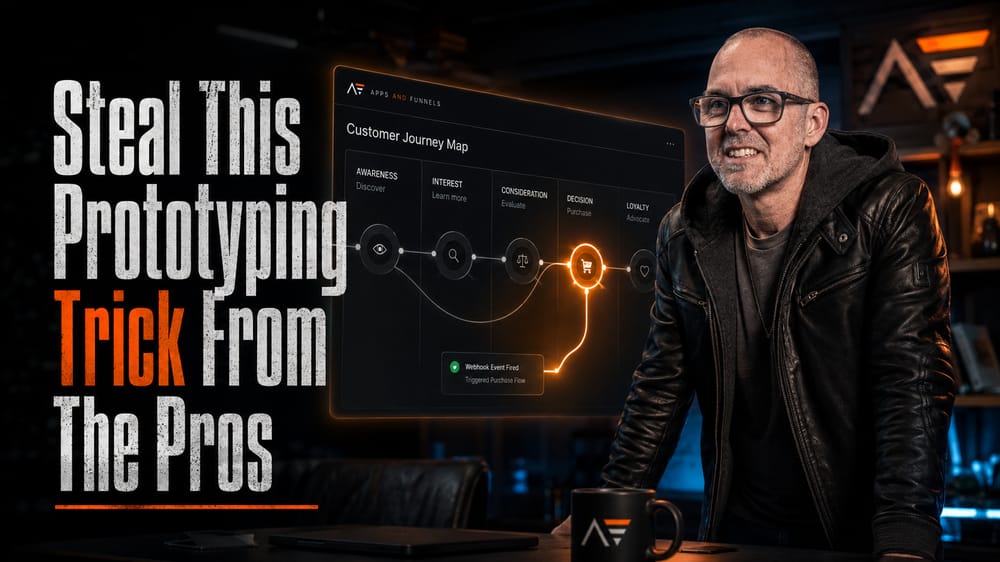
I'm working on a new feature for Funnel Pulse right now. It maps the entire customer journey past the funnel.
Abandoned cart, purchase, delivery, onboarding, all of it, tied together with webhooks so you always know where every one of your people actually is. I haven't seen anything like it in our world.
Which is exactly what made it hard to picture.
I was working it out with an LLM and at first it was just pages of text. Then we moved to ASCII drawings, boxes and arrows, trying to get some shape around the idea.
At one point I had it render actual UI cards, just so I could get a feel for it.
I still couldn't tell if we were circling something valuable, or something confusing, or something unfocused.
So I changed the approach.
The fix is dead simple, even when the feature isn't:
Build the fake version first!
Make it look and feel completely real, and don't touch a real database or app plumbing until you actually know what you're building.
Here's what that looked like for me this week.
Instead of having the LLM build this inside Funnel Pulse itself, I had it take the existing product's look and feel .. the actual design language .. and build one static HTML file.
Fake screens. Hardcoded fake data. Simulated clicks that show and hide different states as you click through the workflow. Nothing real underneath it, no database, no backend, no schema.
I've been in that file for hours today. Wired up a fake webhook from Kajabi, and watched it light up a milestone on the map.
I even added a little wobble animation on the connection. An homage to Propellerhead Reason, if you know it .. patch cables are basically what this whole thing is built on.
If I'd built this in the real codebase, I'd be about a quarter of the way to where I am right now. Same hours. A fraction of the ground covered.
I've been building software for 25 years. Design has always been part of that process, wireframes, prototyping tools, a week of back and forth before a developer touched anything real.
I'll never open Figma for this again. Not when I can build it in my actual design system, click through it, and pull it up on my phone.
That's the part that actually saves you the tokens and the time. Not just on something this unusual, on whatever you're about to build next.
Here's what I've learned running this for hours today:
Stay high level on purpose. Skip the database, the scaling, the roles and the schema until you actually know what you're building.
Have the LLM match your real design language. A stock-template look means you're reacting to a stranger's product, not yours.
Hand off a working prototype instead of a spec. The LLM already knows what "done" looks like, because it built the fake version first, so your result lands a lot closer to what you actually meant.
Use it for my prospects too. I've sent a couple of proposals lately with a link to a clickable prototype instead of a write-up. People get a lot more excited about something they can click through.
If you want the prompt that I used to get the first version going, come check it out in the Apps and Funnels group.
And stay tuned for the full feature coming to Funnel Pulse soon.
If you want something like this built for your business, comment or send a DM.
🚀
- James

Hi, I'm James Curran
Chief Funnel Builder at Linchpin Funnels
We've believed that "Linchpin Is The Way" since FHL 2022 and have been serving the community ever since!
Now It's Your Turn!
Join the Linchpin Funnel Hackers Collective and get your Free Linchpin Funnel as a Bonus!
Copyright © 2025 Linchpin Funnels
Privacy Policy | Terms